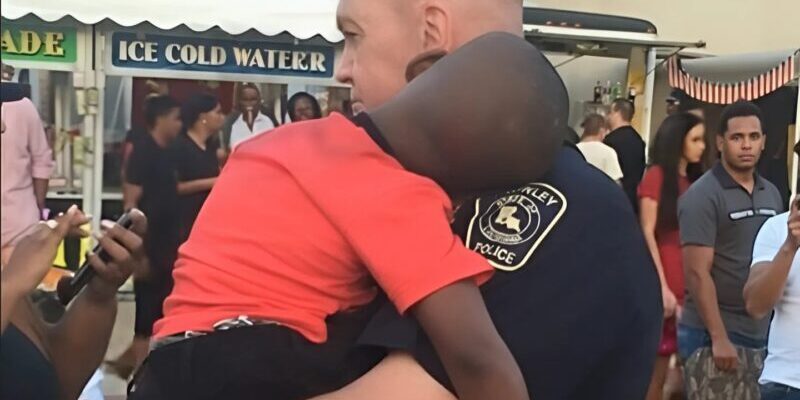
He dozed out in a police officer’s arms  , but that wasn’t the reason why people began muttering.
There was a long line of food trucks, loud music, with kids running and laughing everywhere during the Juneteenth celebration.
I pulled away for a moment to buy a funnel cake. and when I looked around again, my nephew Zavi was gone.
A wave of frigid panic swept over me. I set everything down and stared at every bounce house and child’s face while I started yelling his name. I had been about to call the police when I saw him.
He’d dozed off. in a police officer’s arms.
The cop stood calmly, as if nothing had happened.
I was panting and scared when I got there, and he just said:
He wandered near the ice cream cart. He looked exhausted. I didn’t want to leave him behind.
I embraced Zavi, thanked him, and got ready to go.
But I could feel the glances. The whispers. Other people had taken out their phones.
Some smiled. Not all of them, though. “I guess he got lucky, huh,” mumbled a woman standing near a stand, and shook her head.
I didn’t comprehend at first. And then I realized.
The photo of him sleeping in a police officer’s arms was the only thing on everyone’s mind.
That is, who was holding the infant.
If only one item had been different, it might have appeared as follows.
Since that day, I have been troubled by one question: Would he still have been safe if he hadn’t looked so weak, exhausted, and defenseless?

What made people whisper wasn’t that he fell asleep in a police officer’s arms.
It happened during the commemoration of Juneteenth. Kids were playing, food trucks were lined up, there was music everywhere, and the streets were packed with neighbors celebrating the holiday. I just glanced away to get a funnel cake, and when I looked back again… There was no sign of my nephew Zavi.
Suddenly, I felt panicked. I looked at everyone around me as I sprinted between bounce houses, dropping my plate and shouting his name. I was only a few seconds away from calling the police, and he was sound asleep, cuddled up in an officer’s arms.
The policeman stood calmly to the side, as though this were just another part of his day. He gave me a small nod as I approached him, sweating and trembling. According to him, “Zavi wandered near the slushy stand and fell asleep shortly after.”
“I didn’t want to leave him alone,” he said, as if it were the most normal thing in the world.

After thanking Zavi and bringing him back, I tried to move on. But all around me, people were using their phones and whispering. Others seemed uneasy, while others smiled. Beside a food truck, a woman said, “Not everyone would’ve gotten that kind of treatment,” and shook her head.
I didn’t understand it at first. After then, everything made sense.
People weren’t as interested in Zavi’s nap as they were in who was holding him and what might have happened in a different circumstance.
Since then, I’ve been plagued by the same question: What if he had been older and less immature? What if he hadn’t looked so exhausted and unsophisticated? Would he have received the same kindness?
That doubt was still there, obstinate and inevitable. I kept replaying the scene in my head. He had been really nice, and his name was Officer Davies. He gave Zavi back with a reassuring smile and a brief explanation, acting as though nothing had occurred. Does the story end there?
But the looks, whispers, and unspoken judgments told a different story. A story that bears the invisible weight of racial realities. Instead of napping, what if Zavi had been a little scared and confused?
Had the policeman arrived with the same poise? Had suspicion replaced it?
That night, I couldn’t sleep. Each time I reenacted the scene, the story was different. Every now and then, Zavi would laugh as he inquisitively touched the officer’s badge.
At other times he fidgeted, and I considered how a simple gesture may be misconstrued. In the worst of these visions, the officer’s face clenched as his grip tightened.
The next day, I spoke with my sister, Zavi’s mother. And she had heard the whispers and the glances. And like me, she knew that her son’s skin tone had quietly affected how things turned out.
We decided to talk about it. to strike up a discussion rather than to level the playing field or level the playing field. On social media, we shared an open and sincere description of our experience. In addition to thanking Officer Davies for his kindness, we talked about the unease and unspoken tension that characterized that circumstance.
Many people shared the post. Support, confusion, and anger were among the thousands of comments. Some accused us of “looking for problems.” Others shared personal accounts of how race changed the direction of a simple conversation.

One message stood out in particular. It was said by Officer Davies himself.
He expressed gratitude to us for bringing his actions to our attention and recognized our worries. He was reminded of the challenging road ahead by the occurrence.
Soon after, they received a call from the local police station. By using our story, they aimed to start conversations about unconscious bias and community relations. We were invited to give a speech at a public event.
It felt scary to share something so personal in front of neighbors and cops.
But we were successful.
After Zavi disappeared, we talked about the relief, the ensuing anxiety, and then the uneasiness.
And the question that never goes away: Would the outcome have been the same if only one thing had changed?
Officer Davies was present. He talked, too.
He talked about his wish to contribute to the community, his attempts to listen, and how our common history continues to shape how people view the police and locals.
It was not an easy chat. There were uncomfortable moments, awkward facts, and long silences. However, there was also sincere listening. A step toward the human race. more aware.

From there, an unexpected friendship blossomed. Officer Davies took engaged in community initiatives like training on unconscious bias and youth-and-police meetings. My sister and I persisted in sharing our story, encouraging others to follow suit.
How about Zavi? He is still a contented, energetic child who is unaware of the challenges of that day. But we’ll tell him the whole story in due time. We’ll tell him the truth about the officer’s kindness, the gossip that circulated, and the conversations that followed. We’ll show him the wonders and flaws of the world.
Above all, we will teach him to be watchful, to speak up, and to defend the moral high ground. Because the real lesson at the heart of this story is this:
Even the simplest moment can help with understanding, communication, and perhaps even transformation. Instead of avoiding harsh facts, we grow by facing them head-on. Together.