The old woman was ridiculed in the hospital waiting room until the surgeon came in and said this.
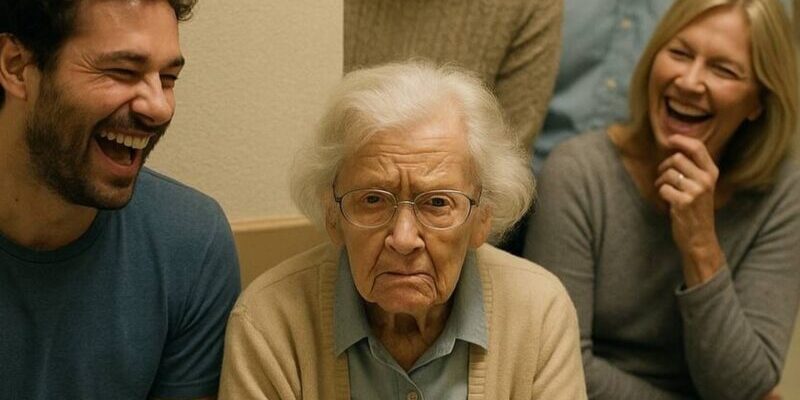
She sat quietly in a corner with a tattered purse in her lap. Her clothing was far too light for the weather, and her shoes were worn and mismatched. No one sat near her in the crowded hospital waiting room, either because they were uncomfortable or because she was unworthy.
A woman drew closer to her husband and said, “She must be lost.” She probably came in from the street.
He chuckled quietly and remarked, “It’s likely that she’s just here for the free coffee.”
A bunch of well-dressed relatives would glance at her, roll their eyes, and laugh every time she moved or opened her suitcase. A nurse even approached gently:
— Ma’am, are you sure you’re in the right place?
She calmly answered:
Yes, sweetheart. I’m in the proper place.
An hour passed. Then two. She kept waiting.
Abruptly, both doors swung open. A man in surgical scrubs came out, his mask hanging over his neck, his hair tousled under his helmet, clearly exhausted. He went straight to the old woman.
The room became chilly. Everyone was observing him. He stopped in front of her, a soft look on his face. Then, loud enough for everyone to hear, he said:
— Are you ready to tell them who you are now?
They teased the old woman in the waiting room. When he came closer, the surgeon said this.
She sat quietly in a corner, holding a battered old pocketbook in her lap. Her clothing was far too light for the temperature, and her shoes were worn and mismatched. In the packed hospital waiting area, most people shunned her, either because they felt uncomfortable or because they thought she was bad.
A woman drew closer to her husband and murmured, “She must have gone lost.” Most likely came in by accident.
“She’s not a patient; she’s waiting for free coffee,” he remarked with a smile.
A group of well-dressed relatives watched her, rolled their eyes, and laughed every time she moved or opened her suitcase. One nurse even approached gently:
— Ma’am, are you sure you’re in the right place?
— “Yes, sweetheart,” she said. I’m in the proper place.
An hour passed. Then two. She waited. At last, the twin doors flew open. A man in full surgical garb came into the room and walked up to the old woman, looking tired, his hair unkempt, his mask down. Everyone was watching him.
He stopped in front of her and said, “Are you ready to tell them who you are now?” with tender eyes.
The room held its breath. The old woman lifted her head slowly, her eyes gleaming. Her lips trembled a little, but her eyes did not waver.
“Well,” she mumbled, “I suppose it’s time.
The surgeon gently grasped her hand. She walked confidently and with a slight hunch back. Those who had just laughed at her stood gaping, frozen in place. In humiliation, the nurse who had asked her turned away.
Speaking to the group, the surgeon said:
This woman is the reason I’m here today.
The room was filled with a rumbling of murmuring.
— My name is Dr. Sebastian Creighton.

I recently underwent a fourteen-hour treatment called a triple bypass. The man wouldn’t have survived without it. And she’s the reason I became a surgeon and succeeded.
He pointed to the woman, who stood erect, her gaze proud.
Her name is Margaret. She is not just an old woman.
She nurtured me when no one else would. She worked two jobs as a maid to pay for my school supplies. She skipped meals so that I could eat. When I informed mom I wanted to be a doctor, she instructed me to “be the best doctor you can be.”
Margaret’s eyes were moist, but she didn’t cry.
“I never knew my real parents,” Dr. Creighton said.
I was placed in foster care when I was three years old. Margaret volunteered there. She looked at me and continued, “That one’s mine now.” Complete silence.
She took me in without any help or money.
Just love. The only reason she waited here for five hours today was because I asked her to stop by after my procedure. Not in an emergency situation. only to embrace her.
He pulled her into an intense embrace. His shoulders were clearly trembling. The applause started. Then another. The waiting room was soon filled with standing and cheering people.
Margaret looked around, puzzled: — Why are they clapping? She whispered.
“Because you deserve to be seen, Mom,” he said with a smile.
The room fell silent, and Margaret sat down beside him. The nurse handed her a cup of boiling tea with shaking hands.
I’m sorry, ma’am.— “There’s nothing to it,” Margaret remarked.

Past appearances are not always visible to us. I’ve done that, too.
One of the women who had teased her stepped forward, uncomfortable and embarrassed.
I didn’t know. I considered…
— “It’s human,” Margaret said. Everyone makes judgments from time to time.
But the surgeon stepped in, eyes unblinking:
“It’s not right because of that.” When the woman said, “No, it doesn’t,” her cheeks flushed.
Margaret leaned back against the wall and smiled:
You know it’s funny. All my life, I was invisible.
It never really worried me. But I’ll see you today. That was important.
Dr. Creighton took her hand and called for a staff member:
Make arrangements for a private vehicle to transport her home. Make sure she has hot food every day of the week as well. When she says she doesn’t need it, don’t listen to her.
“I can still cook,” Margaret remarked.
“Yes, but you shouldn’t have to anymore,” he said.
Before she left, a few patients gave her a silent thank you. One woman said she reminded her of her mother who had passed away. One man said he hoped he will be talked about with such love someday. Margaret smiled, humble yet touched.
But the story didn’t end there. A few days later, someone who saw it posted the story online. No names. Just for the time being. The surgeon. The woman. The lesson. Many people shared the post. Thousands of shares.
Mothers were summoned. Others admitted their past mistakes. Donations to foster homes poured in. Volunteers offered their services as mentors to children. Some even searched for Margaret as a token of appreciation.
Dr. Creighton never publicly confirmed the story. He did, however, post a photo of her smiling in her small kitchen while holding a platter of cookies.
“You raised me with kindness and crumbs,” the caption reads. Today, the world can see the abundance you gave me.
Margaret was not interested in the internet. And she didn’t even have a smartphone. But when she realized that her story was inspiring people to be kinder, she smiled:
And all for just sitting on a chair?
But she knew that it was far more than that.
By the time she returned to the hospital, everything had changed. They embraced her wholeheartedly. She was handed tea without her asking. There was also a handmade blanket on her chair.
Margaret squatted down and used a toy from her purse to distract a young, stressed-out mother and her toddler when they entered.
“Thank you,” the mother whispered, her eyes watering.
We’re all waiting for something, my love.
We might as well make the wait a little more tolerable for someone else.
Margaret finally became a legend in that hospital. Her story was told to the interns. Patients asked:
Is she the female character in the story?

Those who knew would smile:
— Let me present her to you.
Because the quietest spirits tend to leave the deepest marks. The next time you see someone who appears to “not belong,” try not to judge them hastily.
They might be exactly where they ought to be.
and may have already changed someone’s life.